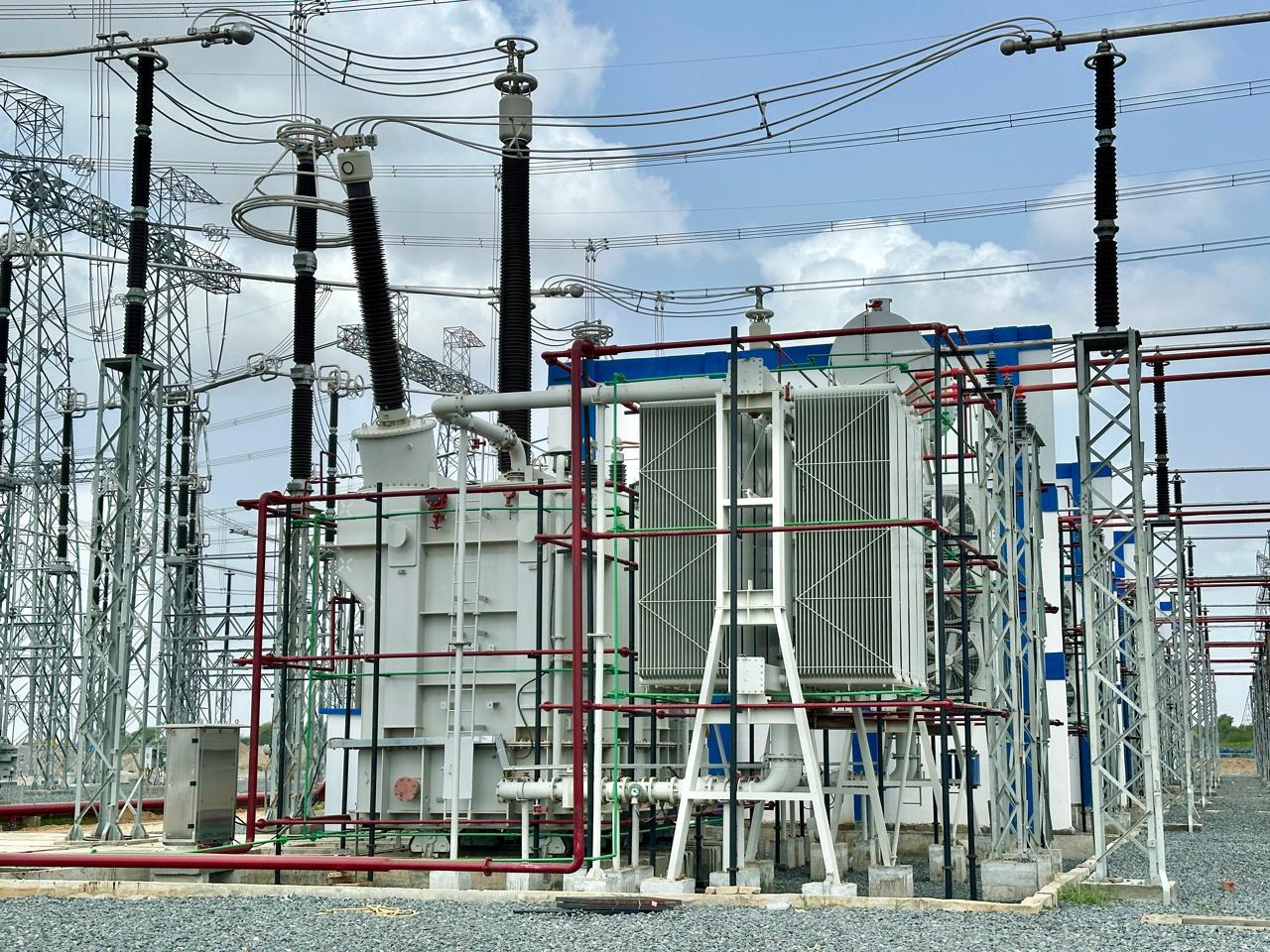
Across the western desert of Rajasthan, a 350 km stretch of steel towers is nearing completion—quietly preparing to carry the next wave of India’s renewable energy.
The Beawar Transmission Limited (BTL) project is part of a larger green energy corridor backed by the Ministry of Power. Its job is precise: move power from Rajasthan’s vast renewable zones to where it is needed, without delay or loss. At full capacity, the corridor will evacuate 4,500 MW of electricity—drawn from a pipeline of nearly 20 GW of new renewable generation.
Running from Fatehgarh to Beawar, the 765 kV double-circuit line cuts across six districts—Jaisalmer, Barmer, Balotra, Jodhpur Gramin, Pali, and Beawar—linking generation hubs to the national grid through a high-capacity spine.
Why this line matters
Rajasthan’s renewable potential is among the highest in India—over 400 GW across wind and solar. But generation without evacuation is stranded capacity.
The state is targeting 90 GW of installed renewable energy by 2030. Without transmission infrastructure, excess generation is often curtailed, particularly during peak wind and solar output. At the same time, demand from agriculture and industry continues to rise, creating a structural mismatch.
BTL addresses both ends of that imbalance—moving clean power out of remote generation zones and stabilising supply across Rajasthan and northern India.

Engineering for scale and variability
The project combines high-capacity transmission with grid-balancing infrastructure:
A 765 kV D/C Fatehgarh–Beawar transmission line forming the core corridor
A 3,000 MVA 765/400 kV AIS substation at Beawar
Two LILO (Line-In-Line-Out) connections improving network flexibility
A Statcom of + - 600 MVAR at Fatehgarh III, enabling realtime voltage control and grid stability
This is infrastructure designed not just for capacity, but for variability—handling the intermittency of renewable energy without destabilising the grid.
Building in the desert, at speed
Execution in Rajasthan’s desert terrain comes with its own constraints—distance, heat, and accessibility. BTL has relied on mechanisation to compress timelines and reduce risk:
Drone-based stringing (Infravision technology) for faster conductor installation
Crane-assisted tower erection to minimise manual handling
Route optimisation to reduce environmental disruption
With over 90% of the project complete, commissioning is targeted for August 2026.


Managing land, people, and perception
Large transmission projects often face resistance—not from engineering complexity, but from land, environmental, and social concerns.
BTL’s approach has been engagement-heavy:
Direct consultations with local communities and landowners
Coordination with industry bodies and civil society groups
Public awareness campaigns to address safety and environmental concerns
Transparent communication through dedicated project channels
The emphasis has been on reducing friction before it becomes delay.
Safety and system reliability
Transmission infrastructure carries inherent public perception risks. BTL’s safety framework addresses both real and perceived hazards:
Towers designed with statutory ground clearances under the Electricity Act
Fully insulated systems—no current flows through tower structures
Fast-acting relays and breakers (<500 ms) to isolate faults
Controlled deployment of machinery in sensitive zones
The system is engineered to fail safely—and recover quickly.
Wildlife in the corridor
Transmission lines in western Rajasthan intersect with fragile ecosystems, including habitats of the endangered Great Indian Bustard.
Mitigation measures include:
Bird flight diverters along the transmission line
Installation of nesting structures
Route alignment to avoid ecologically sensitive zones
Culverts and canopy bridges to maintain animal movement corridors
The goal is not zero impact—that is rarely possible—but measurable reduction.
What this unlocks
BTL is less about a single project and more about system readiness.
It enables full utilisation of renewable assets, improving project economics
Reduces curtailment losses, especially during peak generation
Strengthens grid reliability across Rajasthan and neighbouring states
Creates conditions for industrial growth and investment
In transmission, success is often invisible. Power flows, grids stabilise, and outages don’t happen.
That is the outcome BTL is being built for.